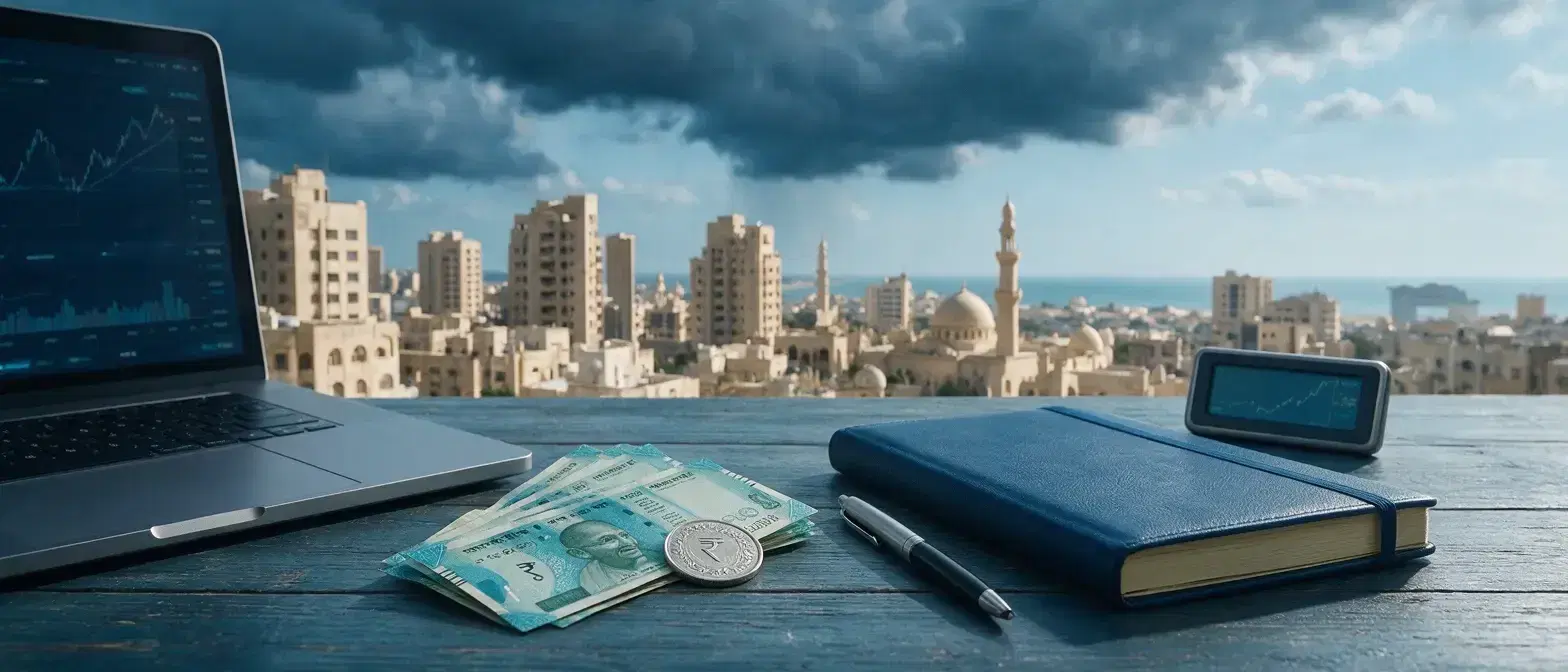
Rupee Hits ₹96.53: What West Asia and Monsoon Risks Mean for Your Wealth
The rupee closed at ₹96.28 last week, its sharpest weekly fall in nine weeks, before slipping further around ₹96.53 on July 21 as oil prices kept climbing. Indian importers had to buy more dollars to pay for that oil, and that's what pushed the rupee down.
That same week, RBI Governor Sanjay Malhotra said India's fundamentals remain strong, but two things could test the country's growth this year: the West Asia crisis and the possibility of a weak monsoon.
Neither of these is a fresh record. The rupee's all-time low was ₹96.96, hit in May 2026 during an earlier flare-up of the same conflict. What's happened since is a record low in May, a partial recovery, and now two straight weeks of the rupee sliding back toward that level. That pattern tells you more than any single day's number does.
Rather than reacting to every daily currency move, Indian investors need to consider what a sensible rupee depreciation investment strategy should look like over time.
After reading this blog, you will understand:
- Why rising oil prices are putting pressure on the rupee
- How a weak monsoon can affect inflation and interest rates
- Why capital outflows are adding to currency pressure
- What a weaker rupee means for your savings and expenses
- How international diversification for Indian investors can reduce dependence on one currency
What Risks Did RBI Governor Malhotra Flag
The RBI Governor’s remarks covered more than just the rupee. He said India grew 7.7% in the last financial year and that the RBI still expects 6.6% growth this year, even with these risks on the table.
But he also raised the RBI's inflation forecast, from 4.6% to 5.1%. Retail inflation had already climbed to 4.38% in June, up from 3.93% in May, with food inflation running even hotter at 5.32%. He attributed the increase mainly to supply-side pressures, which is central-bank language for costs rising faster than demand can explain.
How the West Asia Crisis Reaches the Rupee
For many countries, the West Asia crisis may be seen mainly as a geopolitical issue. For India, it is also a currency and inflation issue.
India depends heavily on imported oil. When global oil prices go up, India has to spend more dollars on energy. This can widen the trade deficit and put pressure on the rupee. A weaker rupee then makes imports even more expensive, pushing up the cost of fuel, transport, manufacturing, and food distribution. Companies may pass some of these costs on to consumers.
The RBI doesn't only watch the rupee. It watches the entire system: inflation, growth, liquidity, interest rates and financial stability, because a shock like this rarely stays contained to one part of the economy.
When the Governor calls the West Asia crisis a growth risk, he's saying the impact can reach beyond oil into business confidence and borrowing costs as well.
The reason oil jumped isn't abstract.
The United States and Iran resumed hostilities, and the fighting has threatened shipping through the Strait of Hormuz, the narrow waterway that carries about a fifth of the world's crude oil. As a major oil importer, India is particularly exposed when disruptions along this route push global energy prices higher.
Broader risk aversion and strong importer demand for dollars have added to the pressure.
Why a Weak Monsoon Is Also a Currency Story
It's easy to treat oil and rain as unrelated risks. They aren't, not from an inflation standpoint.
Agriculture makes up about 17% of India's GDP, and a large share of the rural workforce depends on it directly. Malhotra said the RBI has to stay vigilant about rainfall because of what it does to farm output, rural demand, and food prices. This year's Kharif sowing season has gotten off to a slow start, with planted area running notably behind where it stood at the same point last year.
Follow the chain through.
A weak monsoon can reduce agricultural output and increase pressure on food prices. Food inflation is already the hottest part of the inflation basket. Rising inflation makes the RBI more cautious about cutting rates, and a currency under pressure from an oil shock doesn't need a second source of inflation stacked on top of it. Oil and monsoon aren't two separate risks sitting side by side. They both feed the same inflation and currency dynamic from different directions.
Inside RBI’s Response: Rates, Reserves, and Rupee Support
Beyond talking about it, the RBI has been active on two fronts.
On the currency side, it's likely been intervening through state-run banks, selling dollars to slow the rupee's descent rather than trying to reverse it outright. Analysts are watching the RBI's forward-dollar position, estimated around $106.6 billion, because a large forward book can limit how much room the central bank has to defend the currency if pressure builds further.
On the policy side, the RBI has held its benchmark rate at 5.25% and taken steps to attract foreign currency into the country through channels like NRI deposit schemes, rather than relying only on spending down reserves. The next rate decision comes from the Monetary Policy Committee's meeting in early August.
This combination of smoothing the currency while supporting foreign-currency inflows is a more durable approach than intervention alone, though it buys time rather than removing the underlying cause.
Is This a Rough Patch, or Something Structural?
Here's where it's worth zooming out. A recent Financial Times analysis argued that rupee pressure extends beyond the latest oil shock, pointing to rising capital outflows and broader structural pressures on India’s external position.
That view doesn't have to be the final word, and Malhotra's own comments suggest the RBI sees India's fundamentals as sound enough to absorb these pressures without derailing growth.
But taken together, the picture is more layered than "oil went up, rupee went down." You have a geopolitical shock, a domestic weather risk, and a longer-running structural conversation about import dependence, all converging in the same few weeks.
These overlapping risks show why a rupee depreciation investment strategy should account for both short-term shocks and longer-term currency trends.
The Risk of Holding Rupee-Only Wealth
None of this calls for alarm. It's a case for paying attention to something that's easy to ignore when it moves slowly.
A few practical points worth sitting with:
- Currency moves add up over time. For families expecting future expenses in dollars, understanding how to protect wealth from rupee fall becomes part of long-term financial planning rather than a reaction to one week’s exchange rate.
- Inflation quietly erodes returns. When retail inflation sits above 4%, rupee savings and fixed deposits are working harder just to hold their value, let alone grow it.
- Rate uncertainty affects more than loans. Higher inflation may keep RBI rates elevated, influencing borrowing costs, bond returns, property financing, and equity prices.
- Concentration in one currency and one economy is a risk in itself. If all your assets depend on one currency and economy, the same pressures can affect them at the same time. A measured allocation to global assets may also help hedge against rupee depreciation, although it cannot remove investment or currency risk entirely.
The Bottom Line for Indian Investors
This is not an argument that India’s growth story is in trouble. But the rupee has been one of Asia's weakest-performing currencies in 2026, showing how external pressures can affect its value even when domestic growth remains strong.
Higher oil prices are increasing India’s import costs, uncertainty in West Asia is affecting market confidence, and a weak monsoon could push food inflation higher.
While India’s economic fundamentals remain strong, these risks can still affect the currency, interest rates, and the value of rupee-based wealth.
Investors don't need to react to every daily move, or abandon rupee assets altogether. A practical rupee depreciation investment strategy balances domestic investments with carefully selected global exposure and does not depend entirely on one currency and one economy.
A balanced portfolio can include Indian assets along with carefully selected global or dollar-based investments. This helps reduce concentration risk and makes your wealth better prepared for changes in inflation, interest rates, and the rupee.
For investors whose income, property, and savings are almost entirely India-linked, adding some exposure to dollar-denominated, income-generating assets, like US commercial real estate, is one way to reduce how much a single currency's path affects total wealth.
That's the reasoning behind platforms like Raveum, which let Indian investors use the RBI's own Liberalised Remittance Scheme to access US real estate directly.
The rupee will keep moving with every headline. The question worth asking is how much of your wealth moves with it.
See how Raveum makes that kind of diversification possible!
Frequently Asked Questions (FAQs)
1. Why did the Indian rupee fall to ₹96.46 against the dollar?
The rupee is under pressure because higher oil prices increase India’s demand for US dollars, while geopolitical uncertainty and capital outflows add further strain.
2. What did RBI Governor Sanjay Malhotra say about the rupee and India's growth?
Malhotra said India's fundamentals remain strong, with growth of 7.7% last year and 6.6% expected this year, but flagged the West Asia crisis and a possible weak monsoon as key risks to watch.
3. How does the West Asia crisis affect the Indian rupee?
Tensions in West Asia can disrupt oil supplies and push global energy prices higher, increasing India’s import bill and putting pressure on the rupee.
4. Can a weak monsoon really affect the rupee and inflation?
Yes. Agriculture makes up about 17% of India's GDP. A weak monsoon can reduce farm output and push up food prices, and food inflation is already the hottest part of India's inflation basket, adding pressure that compounds with the oil-driven currency weakness.
5. How can Indian investors reduce their exposure to rupee depreciation?
Since currency, inflation, and rate pressures all affect rupee-only wealth, adding some exposure to dollar-denominated, income-generating assets, such as US commercial real estate, is one way to reduce dependence on a single currency and economy.
6. What does a weaker rupee mean for Indian investors?
A weaker rupee can increase the cost of overseas education, travel, imports, and foreign investments while reducing the global purchasing power of rupee-based wealth.